
三十八台槽、两种压力:酒泉五万标方制氢站的配置算术Thirty-eight tanks, two types of pressure: Configuration calculations for the 50,000-standard-cubic-meter hydrogen station in Jiuquan
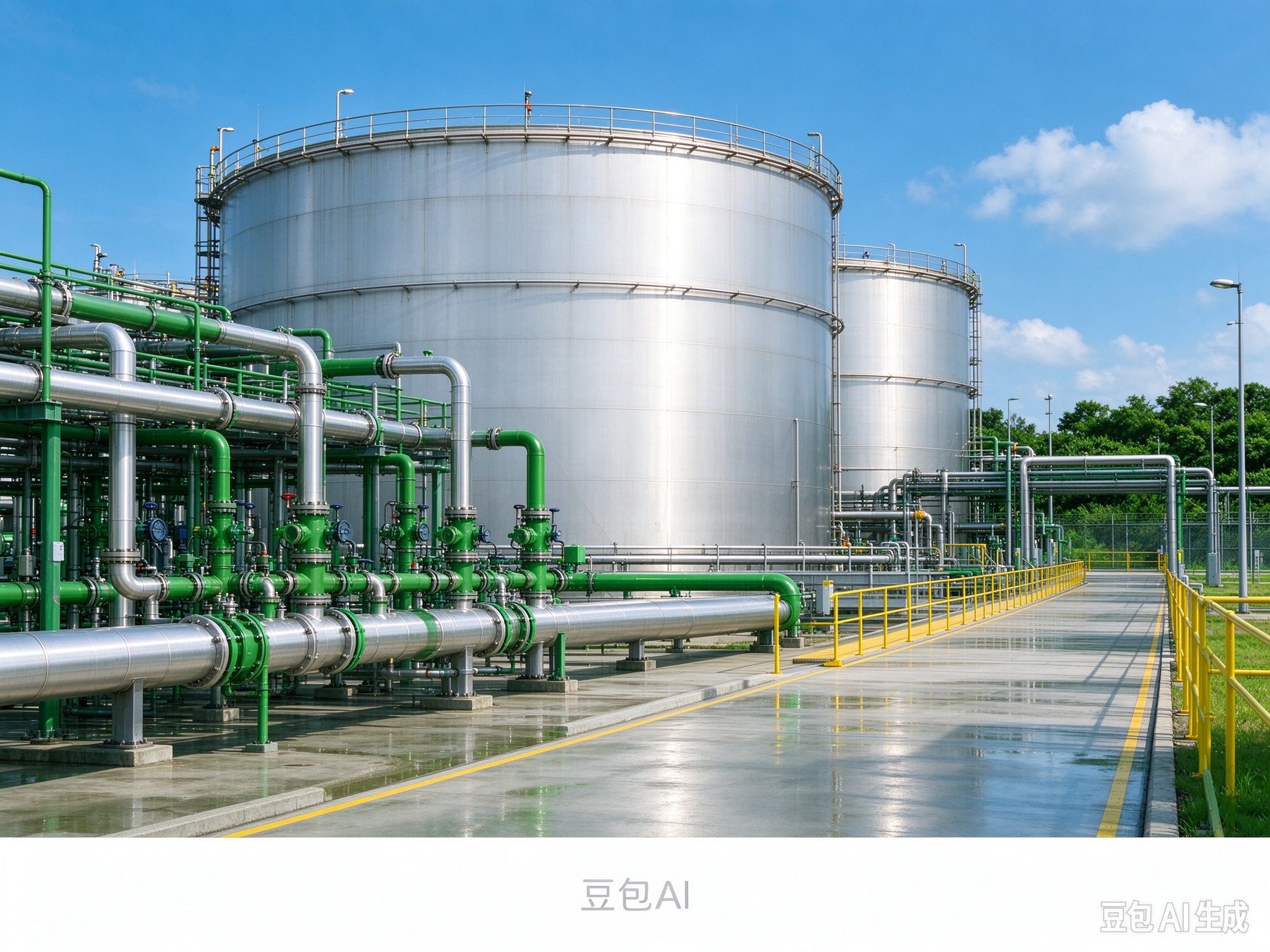
52.07亿元总投资、38台电解槽、5万标方每小时——这份10月10日发布的EPC招标公告,价值不在规模数字,而在于它罕见地把设备清单摊到了台数级别。绿氢项目的配置逻辑最容易被总投资掩盖:产能达标不代表钱花对了地方,储氢够不够、压缩机配得对不对、槽型为什么要分成两种,这些在只看总投资的材料里全部看不见。这份文件因此提供了一个还原一套绿氢站配置逻辑的完整样本。本文分六步复盘:先把50000标方的加法逐项对上,看台数、厂房与纯化框架是否匹配;再拆解常压与中压两种槽型对应的两条压缩链路;然后把57.6万标方储氢折成质量与时长,判断它究竟是日调节还是跨周调节;接着核对储氢前后两级压缩机的压力台阶与流量比,看压缩能力为什么按用氢峰值而不是制氢能力配置;再核一遍5个9纯度、零下70摄氏度露点与1280米海拔带来的设计修正;最后指出三个不能直接横向比较的数字,以及这份清单里最该记住的三个比例。
一、先把50000标方的加法对上
这份招标文件最有价值的地方,是它没有只给一个总规模,而是把台数、单机容量与厂房布置都写了出来。制氢总规模5万标方每小时,3座制氢厂房:厂房一布置8台2500标方每小时方形槽,厂房二16台、厂房三14台1000标方每小时圆形槽。8乘2500加30乘1000,正好50000(来源:中国招标投标公共服务平台招标公告,2026年10月)。
加法能对上,说明这不是一份为了凑总规模拼出来的清单。工程上最怕的是总规模达标、单机与厂房错配——比如把大槽塞进为小槽设计的厂房,或者让一条纯化线去接超出处理能力的产氢量。这份文件在纯化环节明确要求“保证分离、纯化框架处理能力可满足5台电解槽同时运行”,同类表述在国电投大安项目的设备招标里也出现过(来源:氢启未来网,2026年10月)。分离与纯化框架按台数而不是按总气量配置,是这类项目的一个共同做法:台数决定波动工况下的最小处理单元,总气量只决定满负荷时的上限。
再看年产量。年产氢20137吨,按1千克氢气约11.12标准立方米折算,全年产氢约2.24亿标准立方米;除以额定产能50000标方每小时,得到等效满负荷运行约4478小时。换句话说,这套装置的产能利用率约51%。这个数字不是设备能力不足,而是风光耦合项目的常态:电解槽只在电力富余、电价够低的时段满发,其余时段降负荷或停机。设备选型如果按8000小时设计,投资会白花一半。
二、两种槽型不是重复采购,是两条压缩路径
38台槽为什么分成2500标方常压方形与1000标方中压圆形两种?表面看是分散采购风险,实际是压力等级决定的两条工艺链。
常压方形槽的结构特点是电极面积大、电流密度低、槽体为板框式,产气出口接近常压。它的优点是单槽产能大、制造相对简单、适合长周期基荷运行;代价是产出的氢气压力低,要进储罐必须先增压。8台2500标方合计20000标方每小时,占全文总产能的40%。
招标文件里,储氢前配置4台螺杆式氢气压缩机,单台5370标方每小时、出口压力1.6兆帕表压。4乘5370等于21480标方每小时,与8台常压槽的20000标方基本对齐,留了约7%的裕度。这个对齐不是巧合——螺杆机的特点是流量大、压比小、适合低压进气,正是为常压槽这条链配的。这一条是从台数与流量反推出来的工程判断,招标文件未直接写明对应关系。
另一条链是30台1000标方中压圆形槽,合计30000标方每小时,占60%。圆形槽承压结构对称、受力均匀,做中压比板框式容易,出口自带压力,可以直接并入储氢系统,不必再经过一级大流量增压。两条链并行,等于把“大流量低压力”与“中等流量中压力”两种工况分开处理,避免了用一台压缩机去覆盖全部流量区间——那是压缩机能耗最差的运行方式。
这种混配还有一层运行上的考虑。风光出力波动时,先调哪一批槽?常压方形槽单机容量大、调节步长大,适合承担基荷段的粗调;1000标方圆形槽单机小、台数多,适合承担波动段的细调。38台设备分成两种粒度,负荷调节的量化台阶就从2500标方降到1000标方,控制精度提高一倍多。这一层判断属运行逻辑推断,招标文件未披露调节策略。
三、51.8吨储氢,只够一个班次多一点
储氢规模57.6万标准立方米,24座球罐、公称容积2000立方米、设计压力2.1兆帕表压、工作压力不高于1.6兆帕表压、材质16MnDR、三类压力容器(来源:同上招标公告)。
先把标准立方米折成质量:57.6万除以11.12,约51.8吨。再折成时间:按额定产氢50000标方每小时(约4.5吨每小时)计,51.8吨只够11.5小时;按年产20137吨折算的平均产氢(约2.3吨每小时)计,够22.5小时。两个口径给出同一个结论——这是一套日调节级别的储氢,不是跨周、更不是季节性调节。
再验一遍几何与压力的匹配。24座乘2000立方米等于4.8万立方米几何容积,57.6万标准立方米除以4.8万,得到每立方米几何容积对应12标准立方米。理想气体在1.6兆帕表压下约为17倍,实际取12倍,差额来自最低工作压力限制——球罐不能放到零压,放空到某个下限就必须停止取气,这部分是死体积。12倍这个数在工程上是合理的,说明57.6万标方不是拍出来的。
储氢时长这件事,直接决定项目的收益模型。11.5小时的缓冲,够把中午的光伏大发平移到晚高峰,够把夜间的低价风电存到早高峰;但不够把一周的弃风存到下一周,也不够做季节性套利。所以项目的收益必须建立在日内价差与容量补偿上,而不是跨期价差。谁把储氢当成季节库,谁的财务模型就会失真。
球罐材质16MnDR值得单独说一句。这是低温压力容器用钢,D级对应较低的设计温度。金塔县位于河西走廊西端,冬季气温低,选低温钢是常规做法;招标文件未披露具体设计温度,也未披露氢环境下的材料相容性评定方法。氢气对钢材的氢脆影响与压力、纯度、含氧量、应力水平都相关,这部分在公开文件里是空白,属于需要在详细设计阶段回答的问题。
四、压缩机的两级配置暴露了用氢侧的真实需求
储氢之后还有一级压缩:7台往复式氢气压缩机,6开1备,单台26360标方每小时,出口压力4.0兆帕表压。6台同时运行合计15.8万标方每小时。
这个数字需要和制氢能力放在一起看。制氢额定5万标方每小时,而储氢后的压缩能力是15.8万,比值3.16。压缩机不会无缘无故配到产氢能力的三倍——它对应的是用氢侧的峰值流量。项目采用“风光电站开发加制氢加储氢加氢发电”一体化模式,氢气最终要送进氢燃气轮机,燃机满负荷时的耗氢速率远高于电解槽的产氢速率,差额由储氢补足。这就是储氢真正的功能定位:不是存能量,是补流量。
两级压缩的压力台阶也说明了去向。第一级螺杆从常压或低压升到1.6兆帕进罐,第二级往复从1.6兆帕升到4.0兆帕出站。多数重型燃气轮机的氢气供应压力要求在3兆帕量级,4.0兆帕留了管路损失与调节裕度。选择螺杆加往复的组合,是典型的“大流量低压比用螺杆、高压比用往复”的分工,比全用往复省投资,比全用螺杆能达到更高压力。
这里有一处容易被忽略的设计细节:储氢前的4台螺杆压缩机,单台出口1.6兆帕,与球罐工作压力1.6兆帕完全一致。这意味着螺杆机必须能把气体压到罐压才能进气,一旦罐内压力升到1.6兆帕,最后一段压缩就失去压差、流量急剧下降。工程上的解法通常是分缸、末段切换或者降流量运行,招标文件未披露具体方案。这一处如果处理不好,储氢系统的实际充装速率会低于设计值。
五、5个9的纯度与1280米的海拔
产品氢纯度不低于99.999%、露点不高于零下70摄氏度。这个指标高于氢燃气轮机的一般需求——燃机对氢纯度的容忍度通常在99.9%量级,杂质主要影响燃烧稳定性与排放,不至于要求5个9。按5个9配置,说明这套装置的氢气不只供燃机,可能兼顾外供或燃料电池用氢;这部分裕度是否为后续外供预留,招标文件未说明。
露点零下70摄氏度对应的是水分含量在百万分之一量级。深度干燥在工程上靠变压吸附加干燥剂组合实现,再生过程要消耗一部分产品氢或氮气,这部分损耗在设计里必须计入自用率。年产20137吨是净产量还是毛产量,文件未明确。
海拔约1280米这个条件写在风光场区的坐标说明里,制氢站位于产业园内,海拔未单独给出。若按接近1300米考虑,三处设计需要修正:空气密度下降约12%,空压机与空冷器的实际质量流量下降;110千伏外绝缘的爬电比距需要按海拔修正;变频器与变压器的散热能力下降,需要放大冷却面积。这些修正都是常规设计内容,但会实打实抬高造价,公开文件未披露修正系数。
电气配置也值得核对一遍。新建110千伏总降压站1座,主变3乘125兆伏安、110千伏双母线;下游设35/10千伏变电所与各厂房10/0.4千伏变电所。按5万标方每小时、直流电耗4.3千瓦时每标准立方米估算,电解负荷约215兆瓦;3台125兆伏安主变按两台运行一台备用配置,可用容量250兆伏安,对215兆瓦负荷的裕度约16%,加上整流损耗与公用工程,这个配置是紧的但不是不合理。
六、复盘:三个不能直接比较的数字
第一个不能比的是单位投资。制氢厂站25.02亿元除以5万标方每小时,约合5.0万元每标方每小时;内蒙古察右前旗项目制氢端成套设备14395.8万元除以9000标方每小时,约合1.6万元每标方每小时(来源:国际氢能网,2026年10月)。两者相差三倍,但不能据此判断谁贵谁便宜——酒泉这边包含24座球罐、两级压缩、110千伏总降压站、3座厂房与全部土建,察右前旗那边是设备成套采购,不含储氢与压缩。口径不同,比值没有意义。
第二个不能比的是产能利用率。4478小时等效满负荷是从年产20137吨反算出来的,它包含了调试期、检修期与低负荷时段;把它当成设计年利用小时会低估设备能力,当成实际运行小时又会高估。真正可比的口径是投运后连续三年的实际运行小时与启停次数,这两项现在都不存在。
第三个不能比的是槽型优劣。8台2500标方常压方形加30台1000标方中压圆形,这个组合是针对“风光波动加燃机用氢”这一个具体场景算出来的,不能反推哪种槽型更先进。换一个场景——比如纯化工用氢、要求长周期满负荷——两种槽型的配比会完全不同。
把这份招标文件读完,最该记住的不是52.07亿元的总投资,而是三个比例:储氢11.5小时、压缩能力3.16倍、等效满负荷4478小时。这三个数字分别回答了“能存多久”“能供多快”“一年能跑多久”,它们比装机规模更能说明一个绿氢项目到底靠什么挣钱。
【工程实测复盘型·结论】酒泉5万标方每小时制氢站的配置逻辑可以还原成三条链:8套2500标方常压方形槽(合计20000标方)配4台螺杆压缩机(合计21480标方、出口1.6兆帕)进罐,30套1000标方中压圆形槽(合计30000标方)走自带压力路径,储氢后7台往复压缩机(6开1备、单台26360标方、合计15.8万标方、出口4.0兆帕)按燃机峰值供氢。储氢57.6万标方折51.8吨,按额定产氢只够11.5小时,是日调节而非季节调节;年产20137吨折等效满负荷约4478小时,利用率约51%。判断:这套装置的约束不在电解槽,在风光窗口与储氢时长,压缩能力按用氢峰值配置是它最关键的设计选择。
5.207 billion yuan total investment, 38 electrolyzers, 50,000 standard cubic meters per hour—this EPC tender notice released on October 10th is valuable not because of the scale numbers, but because it unusually breaks down the equipment list to the unit level. The logic behind green hydrogen project configurations is easily obscured by total investment: meeting capacity targets does not mean the money is spent in the right place, whether hydrogen storage is sufficient, whether the compressors are properly matched, why the tank types are divided into two kinds—these details are completely invisible in materials that only show total investment. Therefore, this document provides a complete sample for reconstructing the configuration logic of a green hydrogen station. This article reviews it in six steps: first, align the sum of 50,000 standard cubic meters item by item, checking whether the number of units, plant buildings, and purification framework match; then break down the two compression chains corresponding to the atmospheric and medium pressure tank types; next, convert the 576,000 standard cubic meters of hydrogen storage into mass and duration to determine whether it is for daily adjustment or for cross-week regulation;
Next, check the pressure stages and flow ratios of the hydrogen storage compressors before and after, to see why the compression capacity is configured according to hydrogen usage peak rather than hydrogen production capacity; then go over the design corrections brought by 99.999% purity, -70°C dew point, and 1,280 meters altitude; finally, point out three numbers that cannot be directly compared horizontally and the three ratios in this list that should be remembered the most.
1. First, match up the 50,000 standard cubic meters addition
The most valuable part of this tender document is that it does not just give a total scale but lists the number of units, single-unit capacity, and plant layout. The total hydrogen production capacity is 50,000 standard cubic meters per hour, with three hydrogen plants: Plant One is equipped with 8 units of 2,500 standard cubic meters per hour square tanks, Plant Two with 16 units, and Plant Three with 14 units of 1,000 standard cubic meters per hour round tanks. 8 times 2,500 plus 30 times 1,000 equals exactly 50,000 (Source: China Public Tendering and Bidding Service Platform Tender Announcement, October 2026).
The fact that the addition checks out indicates that this is not a list pieced together merely to reach a total scale. What is most feared in engineering is meeting the total scale while mismatching individual units and the plant—for example, putting a large cell into a plant designed for small cells, or having a purification line trying to handle a hydrogen production volume beyond its capacity. This document explicitly requires in the purification section that 'the separation and purification framework processing capacity must be sufficient to run 5 electrolyzer cells simultaneously.' Similar wording has also appeared in the equipment tender for the Guodian Daan project (Source: Hydrogen Future Network, October 2026). Configuring the separation and purification framework based on the number of units rather than total gas volume is a common practice for such projects: the number of units determines the minimum processing unit under fluctuating conditions, while the total gas volume only determines the upper limit at full load.
Next, look at the annual production. The annual hydrogen production is 20,137 tons. Converting with approximately 11.12 standard cubic meters per kilogram of hydrogen, the annual hydrogen output is about 224 million standard cubic meters; dividing by the rated capacity of 50,000 standard cubic meters per hour gives an equivalent full-load operation of about 4,478 hours. In other words, the capacity utilization of this set of equipment is about 51%. This number does not indicate insufficient equipment capability; rather, it is normal for wind-solar hybrid projects: the electrolyzers only operate at full power when electricity is surplus and prices are low, while at other times they reduce load or stop. If the equipment were designed for 8,000 hours, half of the investment would be wasted.
2. The two types of cells are not repetitive purchases, but two compression pathways.
Why are the 38 cells divided into 2,500 standard cubic meters atmospheric square cells and 1,000 standard cubic meters medium-pressure round cells? On the surface, it looks like dispersing procurement risks, but in reality, it is two process chains determined by pressure levels.
The structural characteristics of the atmospheric pressure rectangular cell are that it has a large electrode area, low current density, and the cell body is in a plate-frame design, with the gas outlet close to atmospheric pressure. Its advantages are high single-cell production capacity, relatively simple manufacturing, and suitability for long-cycle base-load operation; the downside is that the hydrogen produced is at low pressure, so it must be pressurized before entering storage tanks. Eight units of 2,500 standard cubic meters each add up to 20,000 standard cubic meters per hour, accounting for 40% of the total capacity mentioned in the text.
According to the tender documents, four screw-type hydrogen compressors are configured before hydrogen storage, each with a capacity of 5,370 standard cubic meters per hour and an outlet pressure of 1.6 MPa gauge. 4 times 5,370 equals 21,480 standard cubic meters per hour, which basically aligns with the 20,000 standard cubic meters per hour of the eight atmospheric pressure cells, leaving about a 7% margin. This alignment is not a coincidence — the characteristic of screw compressors is high flow and low compression ratio, suitable for low-pressure intake, precisely matching the atmospheric pressure cell chain. This conclusion is derived from engineering judgment by working backward from the number of units and flow rates; the tender documents do not explicitly state the corresponding relationship.
The other chain consists of 30 medium-pressure circular tanks with a capacity of 1,000 standard cubic meters each, totaling 30,000 standard cubic meters per hour, accounting for 60%. The circular tanks have a symmetrical pressure-bearing structure and uniform stress, making medium-pressure operation easier than plate-and-frame tanks. The outlets come with pressure, allowing direct integration into the hydrogen storage system without passing through a first-stage high-flow booster. Running the two chains in parallel separates the 'high-flow low-pressure' and 'medium-flow medium-pressure' conditions for processing, avoiding the need for a single compressor to cover the entire flow range—which is the least energy-efficient mode for compressors.
There is another operational consideration for this mixed setup. When wind and solar output fluctuates, which batch of tanks should be adjusted first? The atmospheric-pressure square tanks have large single-unit capacity and large adjustment steps, suitable for coarse adjustments in the baseload range; the 1,000 standard cubic meter circular tanks have small single-unit capacity but many units, suited for fine adjustments during fluctuation periods. Dividing 38 units into two granularities reduces the load adjustment step from 2,500 standard cubic meters to 1,000 standard cubic meters, doubling the control accuracy. This layer of reasoning is inferred from operational logic; the bidding document did not disclose the adjustment strategy.
3. The 51.8 tons of hydrogen storage is only enough for slightly more than one shift.
The hydrogen storage scale is 576,000 standard cubic meters, consisting of 24 spherical tanks with a nominal volume of 2,000 cubic meters, a design pressure of 2.1 MPa gauge, an operating pressure not exceeding 1.6 MPa gauge, made of 16MnDR, and classified as Class III pressure vessels (source: same tender announcement).
First, convert the standard cubic meters to mass: 576,000 divided by 11.12 is approximately 51.8 tons. Then, convert it to time: based on a rated hydrogen production of 50,000 standard cubic meters per hour (about 4.5 tons per hour), 51.8 tons would only last 11.5 hours; based on an annual production of 20,137 tons, the average hydrogen production rate (about 2.3 tons per hour) would last 22.5 hours. Both calculations lead to the same conclusion — this is a daily adjustment level of hydrogen storage, not a weekly, let alone a seasonal, adjustment.
Recheck the matching of geometry and pressure. 24 tanks multiplied by 2,000 cubic meters equals 48,000 cubic meters of geometric volume. Dividing 576,000 standard cubic meters by 48,000 gives 12 standard cubic meters per cubic meter of geometric volume. Ideal gas under 1.6 MPa gauge pressure is about 17 times, but practically we take 12 times; the difference comes from the minimum operating pressure limit—the spherical tank cannot be emptied to zero pressure, and gas withdrawal must stop at a certain lower limit. This part is the dead volume. The factor of 12 is reasonable in engineering, indicating that the 576,000 standard cubic meters figure is not arbitrarily made up.
The hydrogen storage duration directly determines the project's revenue model. An 11.5-hour buffer is enough to shift the midday photovoltaic output to the evening peak, enough to store low-priced nighttime wind power for the morning peak; but it is not enough to store a week's excess wind for the next week, nor enough for seasonal arbitrage. Therefore, the project's revenue must be based on intraday price differences and capacity compensation, not on inter-period price differences. Anyone who treats hydrogen storage as a seasonal reservoir will have a distorted financial model.
The material of the gas cylinder, 16MnDR, is worth mentioning separately. This is steel used for low-temperature pressure vessels, with grade D corresponding to a relatively low design temperature. Jinta County is located at the western end of the Hexi Corridor, where winter temperatures are low, so choosing low-temperature steel is a standard practice; the tender documents do not disclose the specific design temperature, nor do they disclose the method for evaluating material compatibility under a hydrogen environment. The effect of hydrogen embrittlement on steel is related to pressure, purity, oxygen content, and stress levels. This part is blank in the public documents and is a question that needs to be addressed during the detailed design phase.
4. The two-stage configuration of the compressors reveals the actual hydrogen-side demand
After hydrogen storage, there is an additional stage of compression: 7 reciprocating hydrogen compressors, 6 running and 1 standby, each with a capacity of 26,360 standard cubic meters per hour, with an outlet pressure of 4.0 MPa gauge. When 6 units operate simultaneously, the total is 158,000 standard cubic meters per hour.
This number needs to be considered together with the hydrogen production capacity. The hydrogen production is rated at 50,000 standard cubic meters per hour, while the compression capacity after hydrogen storage is 158,000, with a ratio of 3.16. Compressors are not arbitrarily matched to three times the hydrogen production capacity — they correspond to the peak flow on the hydrogen use side. The project adopts an integrated model of 'wind and solar power plant development plus hydrogen production, hydrogen storage, and hydrogen power generation.' The hydrogen will eventually be delivered to the hydrogen gas turbine, and the hydrogen consumption rate at full load of the turbine is far higher than the production rate of the electrolyzer; the difference is supplemented by hydrogen storage. This is the true functional positioning of hydrogen storage: it is not for storing energy, but for supplementing flow.
The pressure stages of the two-stage compression also indicate its destination. The first-stage screw compressor raises the pressure from atmospheric or low pressure to 1.6 MPa into the tank, and the second-stage reciprocating compressor raises it from 1.6 MPa to 4.0 MPa for delivery. Most heavy-duty gas turbines require hydrogen supply pressure in the magnitude of 3 MPa, and the 4.0 MPa leaves room for pipeline losses and regulation tolerance. The choice of a screw-plus-reciprocating combination is a typical division of labor: 'screw for large flow with low pressure ratio, reciprocating for high pressure ratio,' which saves investment compared to using all reciprocating compressors and achieves higher pressure compared to using all screws.
Here is a design detail that is easy to overlook: the four screw compressors before hydrogen storage each have an outlet pressure of 1.6 MPa, which exactly matches the working pressure of the spherical tank at 1.6 MPa. This means that the screw compressors must be able to compress the gas to the tank pressure to allow inflow. Once the pressure in the tank rises to 1.6 MPa, the final stage of compression loses its pressure differential, and the flow rate drops sharply. In engineering practice, the usual solutions are cylinder staging, last-stage switching, or operating at reduced flow, but the tender documents do not disclose the specific scheme. If this issue is not handled well, the actual charging rate of the hydrogen storage system will be lower than the design value.
V. 99.999% Purity and 1,280 Meters of Altitude
The product hydrogen purity is not less than 99.999%, and the dew point does not exceed minus 70 degrees Celsius. This standard is higher than the typical requirements for hydrogen gas turbines—turbines generally tolerate hydrogen purity at around 99.9%, with impurities mainly affecting combustion stability and emissions, so 99.999% is not strictly required. The 99.999% configuration indicates that this hydrogen is not only for turbines but may also be used for external supply or fuel cells; whether this extra margin is reserved for future external supply is not specified in the tender documents.
A dew point of minus 70 degrees Celsius corresponds to a moisture content on the order of one part per million. Deep drying in engineering is achieved through a combination of pressure swing adsorption and desiccants. The regeneration process consumes a portion of the product hydrogen or nitrogen, and this loss must be included in the self-use rate in the design. Whether the annual production of 20,137 tons refers to net or gross output is not specified in the documents.
The altitude of about 1,280 meters is noted in the coordinate description of the wind and solar site, while the hydrogen production station is located within the industrial park, with no separate altitude provided. If considered close to 1,300 meters, three design aspects need to be corrected: the air density decreases by about 12%, resulting in lower actual mass flow rates for the air compressor and air cooler; the creepage distance for 110 kV outdoor insulation needs to be adjusted for altitude; and the heat dissipation capacity of inverters and transformers decreases, requiring an increase in cooling area. These corrections are standard design requirements but will significantly increase costs, and the public documents do not disclose the correction coefficients.
The electrical configuration is also worth checking. A new 110 kV main step-down substation will be built, with three main transformers of 125 MVA each and a 110 kV double bus; downstream, there will be 35/10 kV substations and 10/0.4 kV substations for each plant. Based on an estimate of 50,000 standard cubic meters per hour and a DC power consumption of 4.3 kWh per standard cubic meter, the electrolysis load is about 215 MW; with three 125 MVA main transformers configured as two in operation and one as backup, the usable capacity is 250 MVA, providing a margin of about 16% for the 215 MW load. Including rectifier losses and utilities, this configuration is tight but not unreasonable.
6. Review: Three numbers that cannot be directly compared.
The first thing that cannot be compared is unit investment. The hydrogen production plant in Jiuquan cost 2.502 billion yuan divided by 50,000 standard cubic meters per hour, which is about 50,000 yuan per standard cubic meter per hour; the hydrogen production equipment set for the Chayou Qianqi project in Inner Mongolia cost 143.958 million yuan divided by 9,000 standard cubic meters per hour, which is about 16,000 yuan per standard cubic meter per hour (source: International Hydrogen Energy Network, October 2026). The difference between the two is threefold, but this cannot be used to judge which is more expensive or cheaper—the Jiuquan project includes 24 spherical tanks, two-stage compression, a 110 kV total step-down station, three plant buildings, and all civil works, whereas the Chayou Qianqi case is equipment set procurement and does not include hydrogen storage or compression. The standards are different, so the ratio is meaningless.
The second thing that cannot be compared is capacity utilization. The 4,478 hours of equivalent full load is back-calculated from an annual output of 20,137 tons. It includes periods of commissioning, maintenance, and low load; if taken as design annual utilization hours, it underestimates equipment capability, and if taken as actual operating hours, it overestimates it. The truly comparable measure would be the actual operating hours and start-stop cycles for three consecutive years after commissioning, but both of these data points currently do not exist.
The third thing that cannot be compared is the quality of the tank types. Eight units of 2,500 standard cubic meters at atmospheric pressure in square tanks plus 30 units of 1,000 standard cubic meters at medium pressure in cylindrical tanks—this combination was calculated specifically for the scenario of 'hydrogen for gas turbines under wind and solar fluctuations.' It cannot be used in reverse to determine which tank type is more advanced. Change the scenario—for example, hydrogen for pure chemical use, requiring long-term full-load operation—the ratio of the two tank types would be completely different.
After reading this tender document, the most important thing to remember is not the total investment of 5.207 billion yuan, but three ratios: hydrogen storage for 11.5 hours, compression capacity 3.16 times, and equivalent full-load hours of 4,478 hours. These three numbers respectively answer 'how long can it be stored,' 'how fast can it be supplied,' and 'how long can it run in a year.' They explain a green hydrogen project’s profitability far better than the installed capacity.
[Engineering Measured Review Type · Conclusion] The configuration logic of the 50,000 Nm³/h hydrogen production station in Jiuquan can be reconstructed into three chains: 8 sets of 2,500 Nm³/h atmospheric square tanks (total 20,000 Nm³/h) paired with 4 screw compressors (total 21,480 Nm³/h, outlet 1.6 MPa) feeding into storage tanks; 30 sets of 1,000 Nm³/h medium-pressure cylindrical tanks (total 30,000 Nm³/h) following a self-pressurizing path; after hydrogen storage, 7 reciprocating compressors (6 operating, 1 standby, single unit 26,360 Nm³/h, total 158,000 Nm³/h, outlet 4.0 MPa) supply hydrogen according to the gas turbine peak demand. The hydrogen storage of 576,000 Nm³/h is equivalent to 51.8 tons, which, at rated hydrogen production, is only enough for 11.5 hours—serving as daily adjustment rather than seasonal adjustment; annual production of 20,137 tons corresponds to an equivalent full-load of about 4,478 hours, with a utilization rate of about 51%. Assessment: The constraint of this facility is not in the electrolyzer, but in the wind and solar windows and the duration of hydrogen storage. The compression capacity configured according to peak hydrogen consumption is its most critical design choice.
本网站摘录或转载的属于第三方的信息,目的在于传递更多信息,内容仅供参考。相关股票、投融资等资讯及分析并不代表本网站赞同其意见和对其真实性负责,不构成投资建议。
若不慎涉及侵权,请在相关内容刊发之日起 30 日内联系我们,我们将第一时间进行删除处理。
转载本网资讯请注明来源作者。本网原创文章、研究报告禁止转发。
Information excerpted or reprinted from third parties on this website is intended to convey more information for reference only. Related stocks, investment and financing news and analysis do not represent the endorsement of this website, nor does this website assume responsibility for their authenticity, and do not constitute investment advice.
If any content unintentionally infringes upon rights, please contact us within 30 days from the date of publication, and we will remove it as soon as possible.
When reprinting content from this website, please indicate the source and author. Original articles and research reports of this website may not be redistributed.
提交留言Submit message留下联系方式,平台将把您的需求推送给匹配的产业方Leave your contact details and we will match you with relevant industry partners.
数据来源与口径说明:本平台数据与资讯均以「唯一官方口径」采集与发布,优先采用国家部委、国家统计局、海关总署、中国氢能联盟、IEA / IRENA / IMO 等官方或政府间机构公开数据;同一指标只取一个来源,不做多源拼接。数值为公开发布值,可能因统计口径、产地与发布时间不同而存在差异,仅供参考,不构成交易依据。Data sources and methodology: all data and news on this platform are collected and published from a single official source, giving priority to public data from government bodies and intergovernmental organisations such as the National Bureau of Statistics, the General Administration of Customs, the China Hydrogen Alliance, and IEA / IRENA / IMO. One indicator has one source only and is never stitched together from multiple sources. Figures are published values and may vary with statistical scope, origin and release date. For reference only; not a basis for transactions.
相关信息Related Information同栏目 · 可直接进入各自最终页Same section · each opens its own final page
- 航天炉"点煤成金":从我国第一台自主粉煤加压气化炉到零碳负碳技术转型2026-10-12
- 18至25元对15元:绿氢成本逼近灰氢那一刻,8%至10%的项目收益是靠什么撑起来的2026-10-11
- 视频|海水制氢,中国突破!2026-10-11
- 陕西研制液氢航空地面保障系统完成全流程一体化测试2026-10-11
- 1121.05兆瓦与1062MW:2026上半年电解槽订单两个口径的差,与份额集中到46%的真相2026-10-11
- 从“气”到“氢”的一字之变 四川资阳打造成渝氢走廊氢源配送中心2026-10-10